Thursday, December 24, 2009

Vienna waits for you...

Me and a good friend took a weekend trip to Vienna. In short, it was one of the most wonderful weekends I've had in a long time. The night we arrived, the snow came down heavily, leaving a beautiful white coat of snow over the ground the following morning. Even though cities were immobilized all over Europe and the East Coast due to the unexpected snow storms, it was absolutely delightful to have cold temperatures and snow during this Advent season -- something that, I'm surprised to say, I missed. That, along with some Starbucks gingerbread lattes, made me feel so at home. I fell in love with Vienna this past weekend, and here's why:


Friday, November 6, 2009

Weekend in Sicily

Last weekend, I made a weekend getaway to Sicily with the 3 other Milwaukee students here at the North American College. We had been planning this trip for a few weeks and were excited to finally get it underway, having heard many good things about Sicily.

We flew into Palermo from Rome, and then drove 3.5 hours west to the little city of Taormina. Taormina rests on the shore of the island and is tucked in between cliffs and mountains, with Mount Etna located in the distant horizon--one of Italy's more active volcanoes.


Our first night was devoted to traveling and getting settled at our accommodations. Little could be seen of the landscape on our journey from the airport to Taormina, as most of it occurred during the night. However, when we arrived in Taormina, we approached the city through a tunnel. On one side of the tunnel, one could only see the hills that surround the city, but as we came out on the other side of the tunnel, the city appeared lit up by the city lights and tucked into the side of the hill--quite majestic. That night, we ventured into the city center to find a place to eat. We strolled along the medieval streets lit up by modern shops and dotted with inviting bakeries. Taormina is a charming city with hidden treasures, such as a romantic restaurant tucked away on side streets.


The next day, we planned our morning around a visit to the ancient Greek theater that sits high above the city, with many beautiful views. We woke up to a clear day and prayed before the beautiful view from our hotel balcony:


We meandered our way around the city, to see what we had not seen the night before, and slowly made our way to the theater. On the way, we stopped in gorgeous churches stuck amidst grand landscapes and ancient architecture.


Once we finally got to the theater, I was amazed at what I saw. The theater alone is well preserved, and is a sight to be seen in itself. However, it is placed in such a way that it is completely surrounded by beautiful views and landscapes. After a few hours of picture taking, here is what I came out with:


In short, it was an amazing experience and a sight to be seen. Shortly after, we decided to make a trek up the side of Mount Etna, in search for flowing lava. After a pause for a delicious Sicilian lunch, we made our way up the mountain as it slowly became cooler and more desolate. It was beautiful to see the leaves changing colors on the side of the mountain. It finally felt like fall, and reminded me of those crisp fall days back home.


After ascending the mountain, we were disappointed not to find any lava. However, what we did find was almost as cool--the destructed remains of former lava flows. We are talking acres upon acres of destruction, both of things natural and man-made.


After a long day of touring both man-made and natural wonders, we decided to build fraternity over a typical Sicilian meal. Sicily is known for their great seafood, most uniquely when served raw, as well as their unique flavors and great wine. We dined at a restaurant recommended by various sources, and we were not let down. The food in Sicily may be the part that leaves an impression on me the most.

On our final day, we took our time driving back to Palermo for the flight home, stopping at more quaint villages on the way. Driving along the coast, we had the opportunity to see plenty of amazing landscapes. Before arriving to the airport, we stopped at a nearby village called Monreale, where one of the most beautiful cathedrals is located. The cathedral is known for its well preserved mosaics, which line the walls of the interior of the church.


It was a wonderful experience, and I was blessed to have it. What made it more meangingful, however, was the fact that I was able to share it with some of the men who I will be serving with for the Archdiocese of Milwaukee 4 years from now, please God.

Wednesday, October 7, 2009

Reflections from Greccio

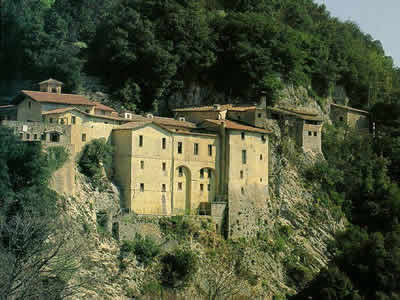
For the past 3 weeks, the individual classes at the North American College have been escaping for a week of silent retreats before the start of the academic year. Last week, our class spent our retreat in Greccio--the city where St. Francis of Assisi formed the first creche (live nativity scene). The city, if it is big enough to be classified as a city, is situated in a mountainous region to the north of Rome. It was there that we spent a number of days, united as a class, but in complete silence to pray and spend time with the Lord...

There were many graces received that week, however, I want to share a few insights that I gained while in prayer. Take them for what it's worth:

Firstly, I want to emphasize how crucial it is for us as Catholic Christians to strive to encounter the love of God through a personal relationship with Jesus Christ. This is one of the fundamental beliefs of Christianity that we ought to treasure as a gift: the fact that God came to earth and became man, and invites us to enter into a PERSONAL relationship with Him. That is, He loves us like no other as a unique person made in the image and likeness of God, Himself. He knows us better than we know ourselves. He loves us so passionately that His heart literally burns for us. This love is so immense, and it is a gift! All we have to do is accept it.

That relationship is so important, because it is the foundation of our relationships with one another. Without experiencing divine love, we can only love one another with a mortal love, which is fallen and imperfect. However, if we accept the love of God and reciprocate that love, it cannot remain within us. We are forced to pour out the love we have received from God to others. God is love. Thus, if we want to love one another, we must first love and accept God, who is love.

Secondly, it is important for us to remember how truly merciful God is. As St. Therese of Lisieux says, "You may truly say that if I had committed all possible crimes, I would still have the same confidence; I would feel that this multitude of offenses would be like a drop of water thrown into a flaming furnace" (Manuscrits autobiographiques, 313). With contrite hearts, yet humble confidence, rejoice in the fact that God wishes to forgive us and pick us up when we fall--that is the beauty of the sacrament of Penance. And what's more, as St. Paul says, "I will boast all the more gladly about my weaknesses, so that Christ's power may rest on me" (2 Corinthians 12:9b). That is, when we are in most need of God's assistance, He willingly fills us with the graces needed to love Him! So, the next time you think "I can't do this," think of God saying "You're right, you can't, but we can!"

On her deathbed, Mother Theresa expressed concern to her sisters that they still have not encountered the love of Christ. I beg you to open your heart to accept God, who is immense love. When you become aware of His love, it is something truly better than anything that can be received on earth--it is supernatural! How do you start? Pray, and trust that God will provide. God always provides.

Wednesday, September 16, 2009

Visiting St. Peter


Archbishop Dolan has a little known book out entitled To Whom Shall We Go?, which is a series of reflections on the Gospel passages surrounding the relationship between Christ and St. Peter. I have been reading it lately after being so incredibly inspired by recent excursions to the Basilica of St. Peter to have Mass with the rest of the PNAC (Pontifical North American College) community, and a recent Scavi tour--a tour of the excavations below the basilica, which contains the bones of St. Peter himself!

I had taken the Scavi tour before, but for whatever reason, this time was special. Maybe it was due to the fact that I took the tour with a group of fellow brother seminarians who understood and appreciated the experience as much as I did, making it more prayerful and significant. I can't fully describe the Scavi tour itself, but I can say that after leaving the tour, I was speechless. I really began to understand, on a different level than ever before, the man who is St. Peter, Christ's 'right hand man,' and the rock upon which Christ built His Church. However, one does not need to come to Rome, necessarily, in order to encounter Peter, and hopefully Christ, in such a way. Granted, it would be a wonderful blessing to do so, but we can encounter Christ and the people He surrounded Himself with through the Gospels.

The Gospels should be our primary source of coming to know Christ. However, Archbishop Dolan's book does a wonderful job of supplementing the Gospel passages with his own personal reflections on the life of St. Peter and his interaction with Christ. Although I could harp about all the wonderful things that I have learned from the Archbishop's words, I want to single out one aspect that both Christ and Peter knew very well--the Cross.

In short, the Cross is what brings us salvation. Thus, it is only necessary that we participate in the Cross that Christ endured in order to hope for salvation. That is something that I have encountered more intimately since arriving in Rome--the redemptive suffering that Christ exemplified on the Cross. As I have mentioned previously, I have encountered a number of difficulties since arriving in Rome. Before I cause scandal I must emphasize that they are natural, healthy, difficulties, such as struggling to adapt to a new environment, missing family and friends at times, etc. However, it is through the various difficulties in our life (or mini-crosses, if you will) that we encounter Christ more than ever.

Is that really surprising to us? As Christ says in Luke's gospel, "If anyone wishes to come after Me, he must deny himself, and take up his cross daily and follow Me" (9:23). Jesus describes it so clearly, and yet, it is so incredibly difficult for us to accept. Why? Because we live in a world that wants us to forget that principle. Let me borrow the words of the Archbishop:

"Satan tries to convince us that the Cross [is] a sign of failure; Our Lord Jesus Christ tells us it's a sign of victory. Facing and embracing our Cross is the way to our salvation--and that's why Satan hates it! That's why he tries to talk us out of it, because he doesn't want us to reach salvation" (Dolan 71).

What it most impressing, in my opinion, about the passion of our Lord is the fact that He carried it out in complete humility and submission to the will of the Father.
When He was betrayed by His best friends, He remained silent and committed to the will of the Father. When He was judged unjustly, He remained silent and committed to the will of the Father. When He was scourged, spat upon, beaten, mocked, all with the weight of the Cross bearing down upon Him, He remained silent and committed to the will of the Father. Finally, when He was nailed to the Cross and left to die, He remained faithful to the Father, even forgiving those who crucified Him. There is a beautiful line in Mel Gibson's "The Passion of the Christ," when Mary says to herself with such emotion: "My Son...when, where, how...will You choose to be delivered of this?" This perfectly exemplifies the humility of Christ in that at any moment He could have delivered Himself from the passion, yet, He remained silent and committed to the will of the Father.

Certainly, we could learn all there is to learn about embracing the Cross through Christ. However, I think Mary exemplifies the sweetness of the Cross in just as admirable a way. As Christ told the apostles to "watch and pray," so does Mary throughout the entire passion. She embraces her cross just as Christ did. How greatly she must have grieved to witness her only son handed over to be condemned, scourged, crucified, and killed before the public. Yet, she embraced the cross by walking with Him every step of the way. Yes, we can learn much from Mary's example, for we are not called, nor are we able to achieve salvation on our own with or without the Cross--it's Christ who does the saving. However, we are called to participate in Christ's suffering, that we may be united with Him through His suffering. Mary does that perfectly. She unites herself with her son, piercing her own heart in the process, and sharing in Christ's suffering. Mary, too, remained silent and committed to the will of the Father.

We all have crosses in our lives, some easier than others. In any event, let us strive to embrace the cross we are given, not for our own benefit, but to participate in Christ's suffering--the suffering that was born from unconditional, unending love for us all. We can't expect to bear our crosses for our own personal gain. What would be the purpose of suffering if it was only directed to ourselves. Rather, our suffering must be directed to God, who is Love, and suffered for us because of His immense love. Can't we strive to do the same in return?


Saturday, September 12, 2009

Close to Home


I didn't have many expectations before the start of my time here in Rome. I think it's fair to say that my mind was most focused on and concerned with the fact that I would be leaving many things: friends, family, familiar lifestyle, my Archdiocese, my home! I mentioned in a previous post about a homily given within the first week of my arrival by one of my formators, who spoke about the surrendering of the life left behind in order that Christ may sanctify it.

Well, I've had a similar moment of grace bestowed upon me within these past couple of months here in Rome. I know that one of the major opportunities available here in Rome is the chance to understand, more fully, the universal Church. The chance to be at the heart of the Catholic Church, a stone's throw away from the rock of our Church, Peter, is definitely an opportunity that will form me in such a way that I will be able to share that with my home, the Archdiocese of Milwaukee--certainly not without the grace of God.

What I have noticed is, since my arrival at the North American College in Rome, I have felt a stronger connection with the universal Church. More significant, however, is the fact that I feel a much deeper connection to the Church in the Archdiocese of Milwaukee. As good or bad as it sounds, living in Italy amidst the Catholic communities here causes me to appreciate the faithful back home. Since being removed from the Archdiocese, I have come to love and appreciate it more than ever. Living in a diverse seminary community, which itself is secluded from the rest of the city of Rome, causes me to appreciate where I came from, where I grew up, where I was raised in the faith. We have much to be proud of in our Archdiocese. We are blessed with faithful parishioners, holy priests and religious, and good bishops who shepherd us as Christ did.

Yes, there is much to be proud of. I am honored to live in Rome, in a community of seminarians from dioceses across the nation, and represent the Archdiocese of Milwaukee. I can humbly and gratefully boast in the graces that God has bestowed upon the faithful in southeastern Wisconsin. It is said, 'you don't know what you got, til it's gone.' I think that rings true here in Rome where, although I am blessed to be studying at the heart of the Catholic Church, I am also filled with hope and joy knowing that I will return, God willing, a servant priest of Jesus Christ for the Archdiocese of Milwaukee, where my heart remains.

Monday, September 7, 2009

Chianti


The Dante Alighieri school in Siena offers additional events aside from the everyday classes to allow for more opportunities to learn the Italian language and culture. One of these events was a trip to Castelnuovo, a small city that sits in the middle of the Chianti vineyards. About 20 other students and I took a bus out to the Tuscan countryside to take a tour of the vineyards that produce this famous wine. We toured around a museum, as well as the beautiful village itself, and we ended the day with a trip out to a wine factory to taste a few different types of Chianti—the best part! It was a very enjoyable trip on one of the last days of my time in Siena. Here are some pictures highlighting the trip…


Wednesday, September 2, 2009

Firenze

This past weekend I decided to take a day trip to Florence with four other seminarians. We took the first bus of the day and spent an hour driving through the Tuscan countryside at 6:30 in the morning. We arrived before most shops and sites had even opened. Our first target was the Uffizi, Florence’s most popular art gallery. Seeing as the Uffizi is notorious for its long lines, we were happy to arrive early and be the second group of the day to enter the museum. The Uffizi is filled with some of the most popular pieces of religious art. In it, one can find works from Michelangelo, Rembrandt, and Leonardo da Vinci, among others. I always love spending time in museums that hold beautiful works of art because they have two effects. First, I am amazed by the talent of the artists to blend colors, shapes and render tones in such a beautiful and objectively talented way. Secondly, they cause me to ponder the grandeur and glory of God. I think of the work, creativity, passion, love, and talent that it takes to produce such a beautiful piece. I am drawn to think of what went on in the head of the artist who created that particular piece—surely it was the subject of that piece. Thus, if an artist set out to paint a picture of the Virgin Mary and the Child Jesus, they must have been on the mind of the artist for quite some time. Thus, it seems to me to be a form of prayer. I suppose you can fill in the gaps, but in short, these works really filled me with awe.

Immediately after the Uffizi, we headed to the convent and museum of San Marco, another exhibit of wonderful and also famous works of art—not to mention a sacred space that was dedicated to prayer and ministry for centuries. The wonderful part about San Marco is the fact that these paintings are still in their original habitat. Arguably the most famous painting in San Marco is the Annunciation.

Close to San Marco is the The Basilica della Santissima Annunziata—a wonderfully beautiful Servite Church where we were able to celebrate Mass. I even went to confession in Italian for the first time—one of the more beautiful experiences I have had throughout the past 4 weeks.

Back in Siena, the seminarians have a separate class with a pious, kind, beautiful woman on specific Catholic and theological terminology. I call in religious education in Italian. This teacher of ours recommended us to a restaurant owned by a friend of her brother. We ate pranzo at this restaurant and enjoyed a nice break from walking vigorously all morning. After pranzo, we were off to San Miniato, a beautiful Church located on a bluff that overlooks all of Florence—one of the most captivating views that I have ever seen. We crossed over the Ponte Vecchio, and walked up a penitential hill to pray at this church in one of the more tranquil sections of Florence.

After descending the “mountain,” we decided to take a trip over to the Basilica of Santa Croce, but not before stopping for gelato at the gelateria of our Italian professor’s brother. Wonderful stuff! We spent a good chunk of time meandering through the Basilica and praying before the many beautiful images in the church, as well as visiting the tombs of Galileo, Dante Alighieri, and others. By this time, we had walked, seen, and experienced more than we could handle, so we decided to conclude our excursion to Florence and take the bus back to Siena.

Before visiting Florence, I had an idea of the rich art and culture that is preserved in the city. However, I quickly became aware of how little an idea I really had. As mentioned previously, I was moved, on numerous occasions, by the various religious art pieces that were on display in the churches and museums that we visited. It is truly breathtaking to witness countless masterpieces in such a short period of time. What’s more is the fact that I was able to share in the beauty of the city with some of my good friends who appreciated it, I’m sure, just as much as I did. Overall, it was well worth the trip!


Friday, August 28, 2009

The Palio

Let me preface my remarks by saying this: what I am about to write cannot even begin to explain all that I experienced within the past 24+ hours.

That being said, the city of Siena is split up into 17 contradas, or neighborhoods, only 10 of which have a horse in the race—which contrada gets to race rotates from Palio to Palio. The contrada, historically, is like a large family. When you are born, you are baptized into this family, who takes care of you in times of need or trouble. This has changed over the years, but the Sienese families still take the contrada very seriously. For instance, when being introduced to someone new, you would be introduced as “John, from Giraffa.” Some contradas form enemies with other contradas. You see, there’s a good and a bad side to the Palio. It’s like the Kentucky Derby meets soccer hooliganism. There’s the fun, historical, family friendly event that the city is best known for. But there’s also the dangerous gang-like war that exists between contradas. The event has become more dangerous in recent years with the introduction of weapons—similar to what we see on the streets today. There’s no such thing as a fist fight anymore.

I began the day with Mass at 7:45 am in the Piazza del Campo, which is the large plaza in the middle of the city where the race is held. For the past week, workers have installed fencing and laid down a dirt track for the horses. Thus, the piazza was effectively turned into a horse track. Mass was celebrated outside with the Archbishop—a very simple Mass and a relaxed early morning atmosphere. After the Mass, the final "prova" was held, which is simply a practice race. Naturally, on the day of the race, this practice run was very tranquil--but fun to watch nonetheless.

The rest of the morning was spent recuperating and relaxing until the early afternoon. At 2:00 pm, I attended a service in which each racing horse is blessed by the local priest. Each contrada has its own Church, among other things, where the horse is brought in before the race to be blessed by the parish priest before being paraded, along with the people, to the Cathedral where each contrada is blessed by the Archbishop. This blessing at the local Church is an emotion filled, prideful event—straight out of the movie 300. After the priest screams “[horse’s name]…Go! And come back victorious!” (in Italian, of course) the contrada begins its charged-up parade to the Cathedral, and then finally, to the Campo for the race.

The seminarians and I decided to get a good position along a side street where each contrada passes by on its way to the race. We got there early enough to stand along the side of an apartment building. Our plan was to eventually duck out early enough to get a good spot in the ”infield” of the piazza, which had been already partly filled by people who camped out overnight to stake out a spot. However, as time passed, we were stuck behind rows of people that filled the side street and we could barely move. Eventually, we made our move to cross the street and try to wiggle through the crowd—this plan was quickly thwarted by the first row of bystanders who refused our passage and pushed back across the street—women, mind you! They grow them strong and bull-headed in Siena!

Eventually, I saw a few locals making their way through the merciless crowd and followed my way out to a nearby open street. From there, I went straight to the Piazza to stake out a good spot for the race. At around 4:30/5:00 pm, I was settled into a spot amidst a growing crowd in the middle of the piazza, and only a few feet from the rail—unheard of, considering how late I got in. So, there I stood in the dead heat for a little over 2 hours watching the contradas, dressed in full regalia, parade around the track. Finally, the horses and jockeys appeared from beneath the large tower in the Campo to begin lining up for the race…begin being the operative word. It took just about an hour and a half to start the race in an acceptable manner. Remember that this event hasn’t changed since it began in the middle ages, and therefore, the horses lineup behind a rope—no starting gates like the triple derby! Apparently, the jockeys of each contrada also form enemies and are not exactly courteous when lining up. In addition, the horses jostle and fight, making the lineup that much more difficult. No one has really been able to give me a clear, straight answer as to why the start takes so long, but I do know that it is NOT unusual. My biggest fear was that they would cancel the race and hold it the following day—which happens if the race doesn't begin after an hour and a half (I think we had just under 10 minutes to spare).

So, after a week’s worth of preparations, a long day of festivities, and hours in the sun, the Palio was finished after 3 laps—about 90 seconds. Immediately after the race is finished, the contradas storm the track to walk off with their winning or losing horse. As you might guess, this is the time when some unfriendly words are thrown back and forth, along with few other instances of violent behavior. More often than not, however, everyone leaves the Piazza in peace.

The winning horse, along with its contrada and jockey, are paraded to the Duomo (cathedral) for festivities and celebrations—they even sing the Te Deum. Overall, I must admit, it is quite profane as events inside the Cathedral go—so much so that they remove the Blessed Sacrament from the tabernacle. After a few minutes enjoying the celebrations at the Cathedral by night, I decided to head ‘home’ and get a good night’s sleep.

I kept telling my friend during the day that the Palio is so unique. Everything about it was like nothing I had seen before. Because of this, I had an absolute BLAST! Leading up to the day of the race, I knew I wanted to attend it all, but I had some apprehensions knowing that the streets would be flooded with people, and the sun would be beating down on us all day. In the end, it was so worth it! However, as I mentioned previously, the Palio is not to be told through stories or pictures—it is meant to be experienced. Until you see it all first hand, words can only pretend to do it justice.